Wenglor OPT291 Sensor
Sensor.

$770.00
Part Number
- OPT291
Highlights...
Overview
Features
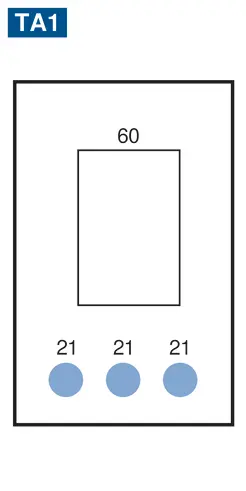
- Graphical display for easy operation
- Emitted light disengageable
- Temperature drift eliminable
- Working Range: 0.1 to 10.1 mm
- Measuring Range: 10 m
- Resolution: 1 to 12 mm
- Linearity (Working Range 0.1…5 m): 0.05 %
- Linearity (Working Range 5…10.1 m): 0.2 %
- Switching Hysteresis: 3 to 20 mm
- Light Source: Laser, red
- Wavelength: 660 nm
- Service Life (T = 77°F): 100,000 h
- Laser Class (EN 60825-1): 2
- Beam Divergence: < 2 mrad
- Light Spot Diameter: see table 1
- Reflector required: no
- Supply Voltage: 12 to 24 V DC
- Current Consumption (Ub = 24 V): < 100 mA
- Switching Frequency: 50 Hz
- Measuring Rate: 1 to 100 /s
- On-/Off-Delay: 0 to 10,000 ms
- Temperature Drift (14°F < Tu < 122°F): < 0.2 mm/K
- Temperature Drift (Tu < 14°F, Tu > 122°F): < 0.4 mm/K
- Temperature Range: -13°F to 140°F
- Number of Switching Outputs: 1
- Switching Output Voltage Drop: < 2.5 V
- Switching Output/Switching Current: 200 mA
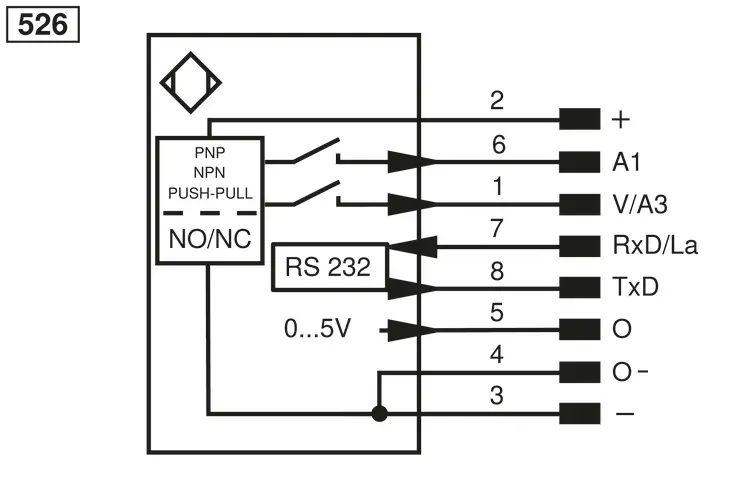
- Analog Output: 0 to 5 V
- Short Circuit Protection: yes
- Reverse Polarity Protection: yes
- Overload Protection: yes
- Interface: RS-232
- Protection Class: III
- Setting Method: Teach-In
- Housing Material: Plastic, ABS, Plastic, PC
- Degree of Protection: IP68
- Connection Type: Plug variant
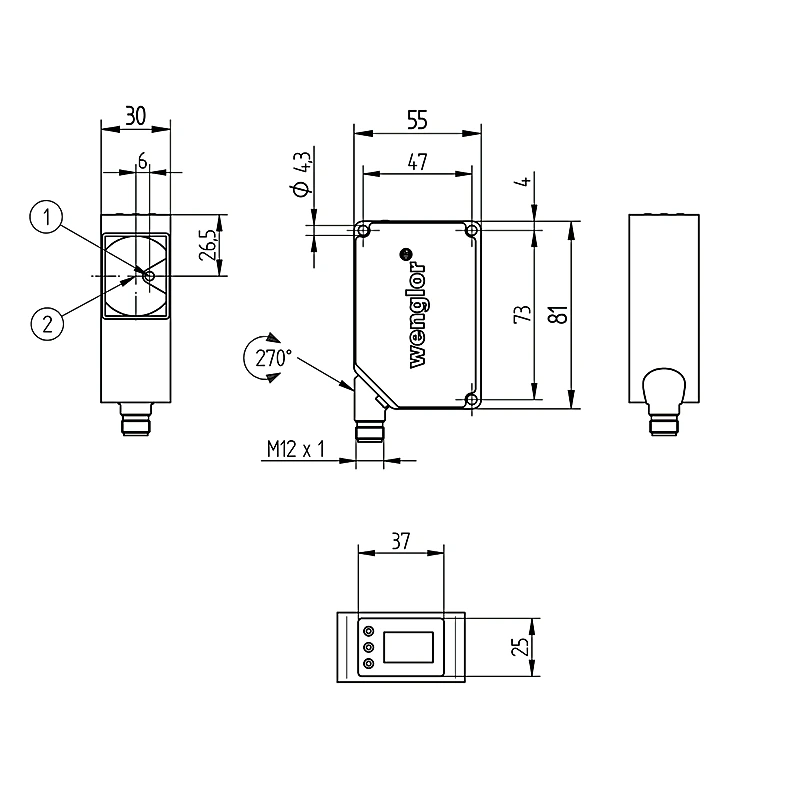
- Connection: M12 × 1; 8-pin
- Weight: 86 g
- MTTFd (EN ISO 13849-1): 346.62 a
- Scope of delivery: 1 × BEF-SET-34 mounting set, 1 × initial start-up instructions, 1 × sensor
- Error Output: yes
- Configurable as PNP/NPN/Push-Pull: yes
- Analog Output: yes
- RS-232 Interface: yes
- Working Distance: 0 m, 10 m
- Light Spot Diameter: 5 mm, < 20 mm
- Complementary Products: Analog Evaluation Unit AW02, Interface Cable S232W3, Set Protective Housing ZST-NN-02, Fieldbus Gateway ZAGxxxN01, EPGG001
Description
These sensors have scratch-resistant optics and the emitted light can be switched off. They use the transit time measurement principle to measure the distance between the sensor and the object. For this reason, the object's color, shape and surface characteristics have practically no influence on measurement results. Even dark objects can be reliably recognized.
Need Help? Call an engineer at 1-802-880-3123
We're open Mo-Th 8am to 5:30pm. Fr 8am to 5pm ET